top of page

New Post

View groups and posts below.


This post is from a suggested group

3.5 mm socket on Audiomoth

Hi! With the 3.5 mm socket on the AudioMoth v1.2.0, would a microphone needing 2.5 Volt plug-in power work (I'm thinking specificaly about the Wildtronics Micro Mic PIP Microphone). Thanks!

74 Views
bnathaye
4 days ago

Thanks for the quick answer Alex!

This post is from a suggested group

Apple Silicon

Will there be a version of the Audiomoth Configuration app that will work with the Apple Silicon chip? Now, with the new MacOS 27, I have to install Rosetta and in about one year the support of Intel-apps will finish.

114 Views

Yes, we’ll update to universal binaries which will work on all Macs in the next updates - before Apple discontinue Rosetta support. In our tests, the native Apple Silicon versions are a lot more responsive and load a lot faster than the Rosetta supported verions.

Edited

This post is from a suggested group

Elian Camilo Torres Castro

Audiomoth seemingly stops recording after creating a 1kb blank audio file

We have deployed 2 audiomoths, both have presented what seems to be the same issue that causes them to stop recording.

The 1st one stopped recording barely a few hours into the first night it was deployed and programmed to start recording, at around 18:00, however it stopped recording at around 20:14, and didnt record anything at all in the next 2 weeks. Since it was my first time using an audiomoth, i chalked it up to me not configuring it properly.

The 2nd one fared much better, as it was deployed on the 12th and succesfully recorded every day in the scheduled hours, until its last file on the 26th, when it stopped at 5:38, and didnt record anything else until we recovered it on the 28th, earlier today.


In both cases, when I opened up the case and went to flip the switch to off, I noticed that…


97 Views

Hi, This sounds like the batteries went flat. Can you confirm what make and model of batteries and SD card you are using. If you use the 'Summarise AudioMoth Files' option under the 'Process' menu in the Config App you can generate a CSV file summarising all the WAV files on the SD card including the comments and the battery voltage before each recording. Can you share those files along with the CONFIG.TXT file from the SD card which will show the configuration settings used. This will help diagnose the problem.

Alex

This post is from a suggested group

More details needed on AudioMoth products

I think I've nearly worked out what I want to buy, but the website has made that very difficult for me through lack of relevant information.


I want to set up BattyBirdNET-Pi. I think the AudioMoth USB microphone and a case is probably all I need to go with my spare RPi4 8Gb. But...


It is conventional for product listings to show product dimensions and photos from all relevant aspects, e.g. showing circuit boards front and back (to show locations of components and ports), and side views when they would be clarifying. Similarly views of cases could show interior as well as exterior, as well as locations of any ports. This website shows only one view of each device, and two views of some (not all) cases.


It appears that the AudioMoth device may have built in battery holders but the AudioMoth USB microphone does not appear to have any…


95 Views

Hi,


Yes, the AudioMoth USB Microphone is powered by USB. There are datasheets describing the dimensions of the boards here: https://www.openacousticdevices.info/datasheets - and various application notes here: https://www.openacousticdevices.info/application-notes This application note describes the AudioMoth USB firmware and hardware: https://github.com/OpenAcousticDevices/Application-Notes/blob/master/Using_the_AudioMoth_USB_Microphone_Firmware_and_Hardware/Using_the_AudioMoth_USB_Microphone_Firmware_and_Hardware.pdf


The AudioMoth USB Microphone case that we sell is only splash proof and is not intended for permanent deployments.


If you are deploying this permanently, you will need to mount the AudioMoth USB Microphone inside some sort of housing with a hole and an acoustic vent to allow the sound to enter. We don't yet sell a fully waterproof housing for the AudioMoth USB Microphone. We may develop one if there is sufficient demand.


Alternatively, people sometimes just waterproof our existing AudioMoth USB Microphone case with an additional plastic bag.

Our external electret microphone is fully waterproof and easy to mount (https://www.openacousticdevices.info/product-page/audiomoth-external-microphone) in a custom housing. It works well for birds does not have the sensitivity of the internal MEMS microphone for bats. An alternative is to use the AudioMoth Dev board inside the AudioMoth Dev Case, and to use the AudioMoth-USB-Microphone firmware on this device. Alex

This post is from a suggested group

Set Up time for visiting a different country

I want to take my audiomoth to New Zealand from UK to record some bats but I wont have access to a PC when there. How can i set up the audiomoth time before leaving UK so I can use the audiomoth chime to set the local time in New Zealand?


I will have an ipad with me but am not aware i can connect the audiomoth to the ipad.


67 Views

Hi, Timezones are always confusing. The default operation is that AudioMoth uses UTC for all timestamps and for the schedule. The acoustic chime sets the time reference held by the AudioMoth using UTC. However, the timezone used for the schedule and the timestamps can also set independently (normally when you configure the schedule in the Config App). For your deployment, there are two options:

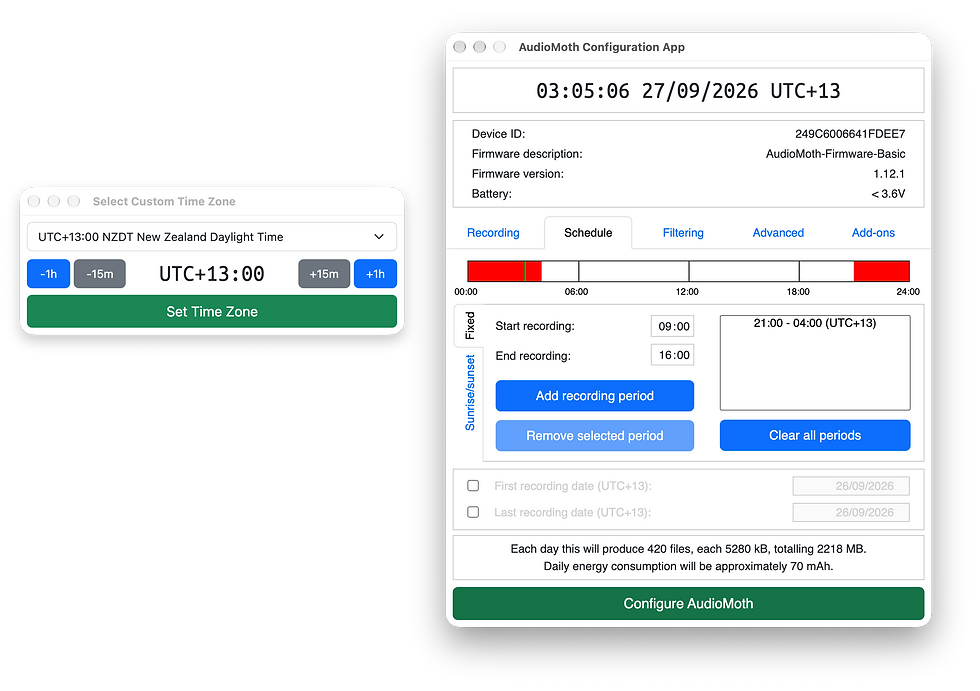
1. Set the custom timezone to New Zealand Daylight time and then enter the recording schedule that you need.


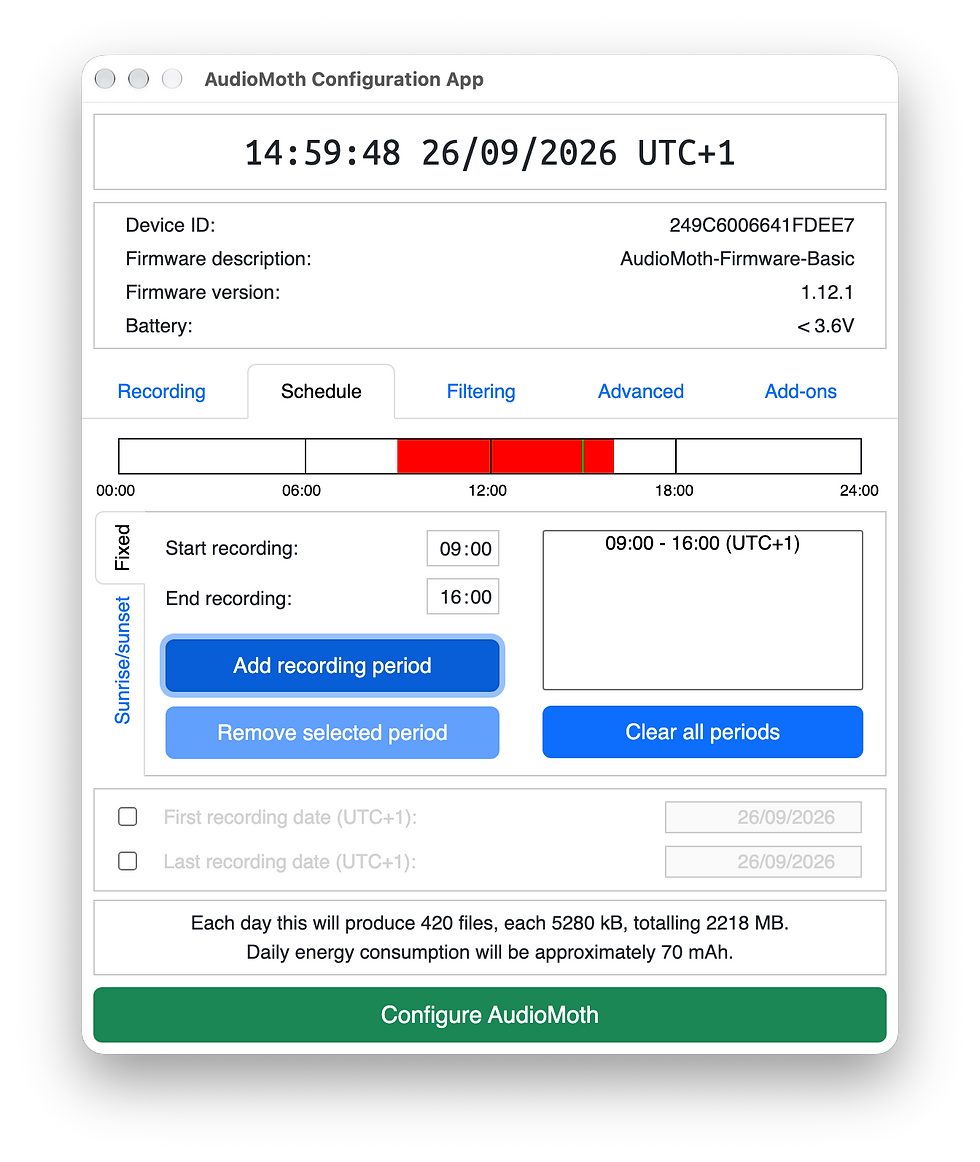
When you use the acoustic chime in New Zealand, the AudioMoth will use the UTC time from the app to update the time, and will always apply the UTC+13 correction, will use UTC+13 for all filenames and timestamps, and use the 09:00 to 16:00 (UTC+13) schedule that has been set. This is the easiest approach. 2. Sometimes you want to use the local time zone which you don't know beforehand, or there may be multiple deployment timezones. You may also want the schedule to adjust to the local timezone. For example, if you schedule 09:00 to 16:00 UTC+1 in the UK, you might actually want it record at 09:00 to 16:00 UTC+13 when deployed in New Zealand, so that they are both recording during equivalent daylight hours. To do that configure normally in local time - UTC+1 below. The schedule will appear as 09:00 - 16:00 (UTC+1) at this point.

Then in the 'Advanced Tab' also enable 'Use time zone in acoustic chime' and 'Also adust schedule to new time zone'. In this case, if you set a schedule of say 09:00 to 16:00 in any timezone in the Config App, it will be adjusted to 09:00 to 16:00 (UTC+13) when in a UTC+13 timezone.


It's also good to enable 'Always require acoustic chime on switching to CUSTOM' to ensure that you always are required to use the chime.

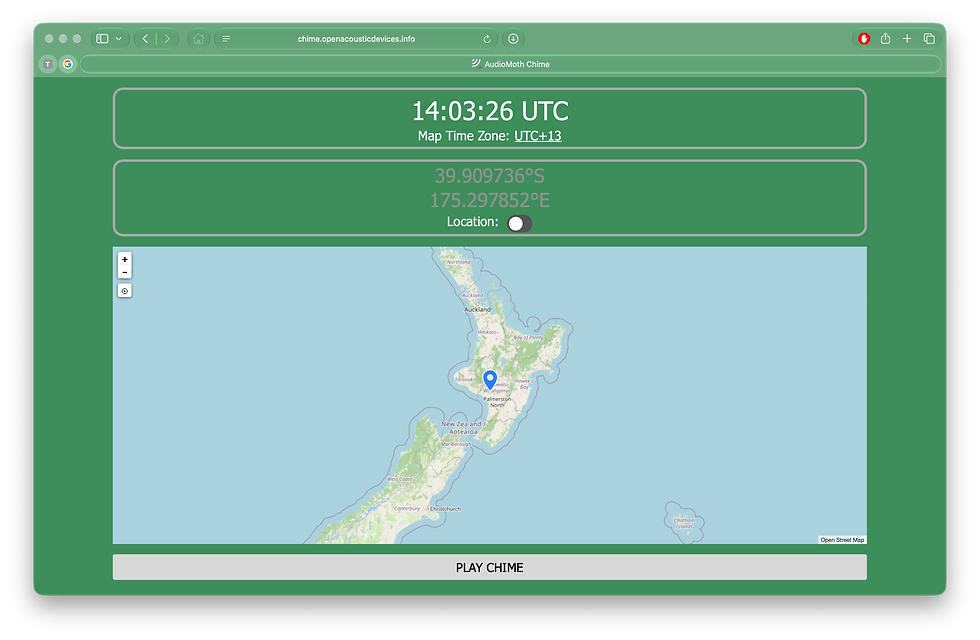
You can try this out by changing the timezone on your smartphone before deployment, or you can use the web based version on a desktop: https://chime.openacousticdevices.info If you click on the underlined timezone shown, you can select to use the timezone from the map location, and try out the chime for any location.

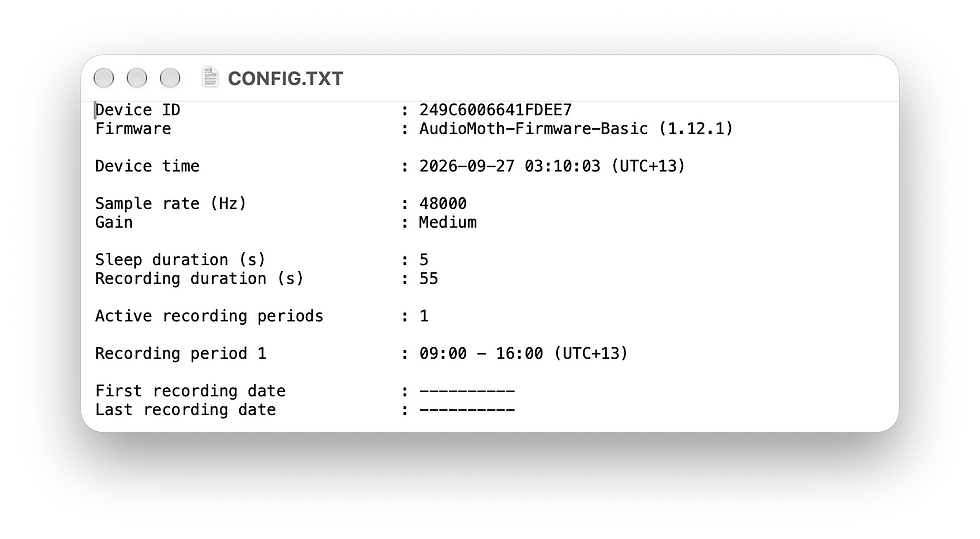
After switching to CUSTOM and playing the chime, the updated timezone and recording schedule will be shown in the CONFIG.TXT file so you can check that the schedule is correct. In the running example here, the device was configured to record 09:00 - 16:00 (UTC+1) but after the UTC+13 chime, the configuration is updated to record 09:00 - 16:00 (UTC+13).

Alex

Edited

This post is from a suggested group

Ben Pluska
Ben Pluska

Help with Arbimon

Hi, I know this is not the right forum for this, but I figure someone could point me in the right direction. I am having problems with the Arbimon uploader. The app on my computer will not let me toggle from site to site anymore. I also get a lot of errors on many of the recordings. I have about 50,000 files uploaded. Could there be an issue with how many files I have put through the uploader? Do I need to clear them out once they are uploaded? Thanks.

74 Views

This post is from a suggested group

Javiera Bristilo
Javiera Bristilo

USB microphone and smartphones

Hi! I‘m looking into purchasing the USB mic for active bat recording using a smartphone (either iphone or android), and the last update I can find on whether it works is from February 2026. I was wondering if currently there are any available mobile apps that support the USB microphones recordings on either one. Thanks in advance!

86 Views

Thanks for the quick reply! To connect the usb mic to an iphone with a C usb connection, is it possible to just buy an adapter and plug it in, or does it require other adjustments?

This post is from a suggested group

Config App Estimation Question

Hi, I’m setting up an AudioMoth for a 2-week bat monitoring deployment in Texas and wanted to confirm that I have the configuration set up correctly for what I’m trying to accomplish.

My current settings are:

  • Sample rate: 250 kHz

  • Gain: Medium

  • Schedule: Sunset to Sunrise

    • 30 minutes before sunset


95 Views

Hi, Yes, the 'up to' means that in the worst case each file might be 4295 MB in size. We would recommend that you also use cyclic recording - something like record for 59:55 and sleep for 00:05. This will mean that the file size is more manageable, and each file will start at the start of each hour, rather than stopping and starting when the file size limit it reached. Energy saver mode improves energy consumption with a small loss in recording quality. It only has an effect at sample rates of 48 kHz and below so will be ignored. The amplitude threshold of 0.002% is very low and I'd expect the AudioMoth to continually trigger with background and self noise at that setting. An initial test deployment at 2% is probably safer. If you already have non-triggered recordings, you can load them in AudioMoth Play (https://play.openacousticdevices.info/) and try out different trigger settings.

The biggest variation in energy consumption is caused by the SD cards. At high sample rates, some cards can use 2 or 3 times as much as others. See the table and application note below.

https://github.com/OpenAcousticDevices/Application-Notes/blob/master/A_Comparison_of_SD_Card_Energy_Consumption/A_Comparison_of_SD_Card_Energy_Consumption.pdf Finally, make sure you use good quality alkaline or high-capacity (>2500 mAh) NiMH batteries. If you can test the settings overnight in a similar environment before the full deployment to check that the trigger settings aren't too sensitive. The red LED will flash about once per second whilst waiting to trigger. When it is actively recording it will flash very quickly and appear nearly continous. You can trigger that by rubbing your hands together in front of the microphone to generate ultrasonics. Alex


This post is from a suggested group

Kevin Chen
Kevin Chen

Compatibility between 1.5V constant-voltage Li-ion batteries and SD cards for 7-day continuous recording at 48kHz

I am trying to set up a 7-day continuous recording at a 48kHz sample rate. However, when using 1.5V rechargeable lithium-ion batteries, I am encountering severe SD card read/write errors. This issue is highly prevalent among a batch of 30 newly purchased devices. Under the exact same configuration, about 1 in 6 devices experiences this issue, and the behavior is becoming increasingly unpredictable.

Hardware Tested:

  • SD Cards: Kingston Canvas Select Plus (256GB); SanDisk High Endurance (32GB, 64GB, 128GB).

  • Batteries: 1.5V Constant-Voltage Li-ion: iNeno AA (3700mWh), Sidande AA (3600mWh); Panasonic NiMH rechargeable (2300mWh); Standard Alkaline batteries.

Observed Issues:

  1. Battery Performance Discrepancies:

116 Views

Hi Alex,


Thank you so much for the quick reply! This is exactly the information I needed.

I do have a quick follow-up question regarding the batteries. Do you have any recommendations for 2850mAh batteries? The brands I am usually familiar with, such as Panasonic, don't seem to produce batteries with this specific capacity.

Could you recommend any reliable brands and specific models that you would suggest for this? Any advice would be greatly appreciated.

Thanks again for your help!


Kevin

©2026 Open Acoustic Devices

bottom of page